

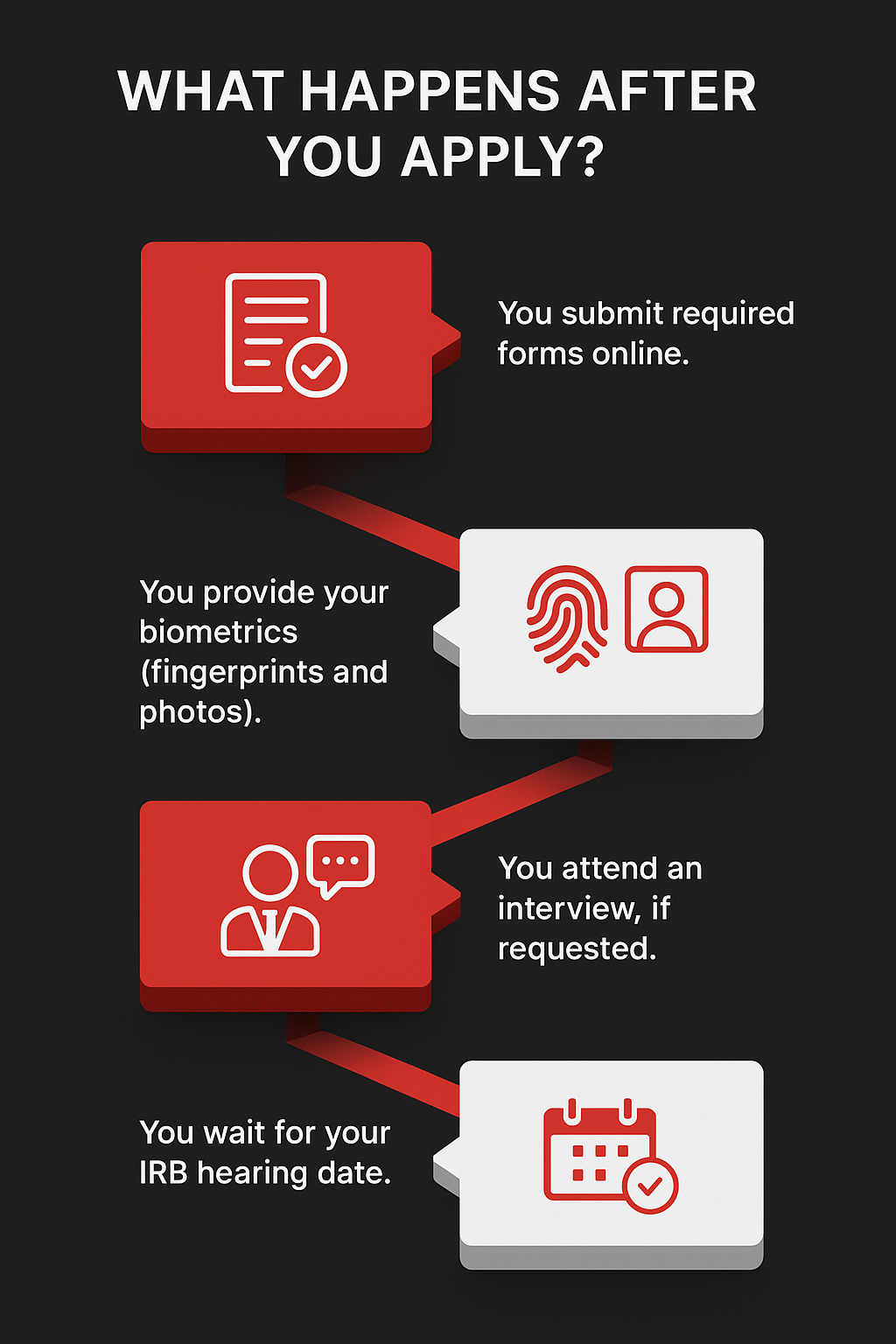
During this time, you may be allowed to apply for:
🔘 A work permit
🔘 Interim health coverage
🔘 Social support services
GARs are referred by UNHCR or a referral partner.
The Government of Canada funds their:
🔘 Housing
🔘 Basic living expenses
🔘 Health coverage
🔘 Settlement support
Support lasts up to 12 months or until the person becomes self-sufficient.
Canada also reserves spaces each year for up to 250 human-rights defenders and their families.
The BVOR program is a partnership between Canadian sponsors and the government.
🔴 Private sponsors: 6 months of financial support + 12 months of settlement support
🔴 Government: 6 months of financial support
This program helps refugees already screened and identified by the UNHCR.
Canada balances humanitarian responsibility with fairness and orderly processing.
To be accepted, applicants must clearly show:
🔘 A genuine need for protection
🔘 They cannot return home safely
🔘 They meet the rules of the category they are applying under
Canada’s refugee system remains one of the most comprehensive in the world, offering protection, safety, and a new start for thousands each year.
Canada is recognized worldwide for offering protection to people fleeing danger, persecution, war, and human-rights abuses. The refugee system includes two major pathways:
🔴 Making a refugee claim inside Canada or at the border (asylum).
🔴 Being resettled from outside Canada through government or private sponsorship.
This page explains each pathway in detail, who qualifies, how decisions are made, and what support is available.
If you are already in Canada and fear returning to your home country because of serious danger or persecution, you may request refugee protection. However, you must first be eligible.
Your refugee claim may be ineligible if:
🔴 You already have protected person status in Canada.
🔴 You are under a removal order.
🔴 You previously made a refugee claim in Canada and it was refused, abandoned, or withdrawn.
🔴 You enter from the United States under rules affected by the Safe Third Country Agreement (STCA).
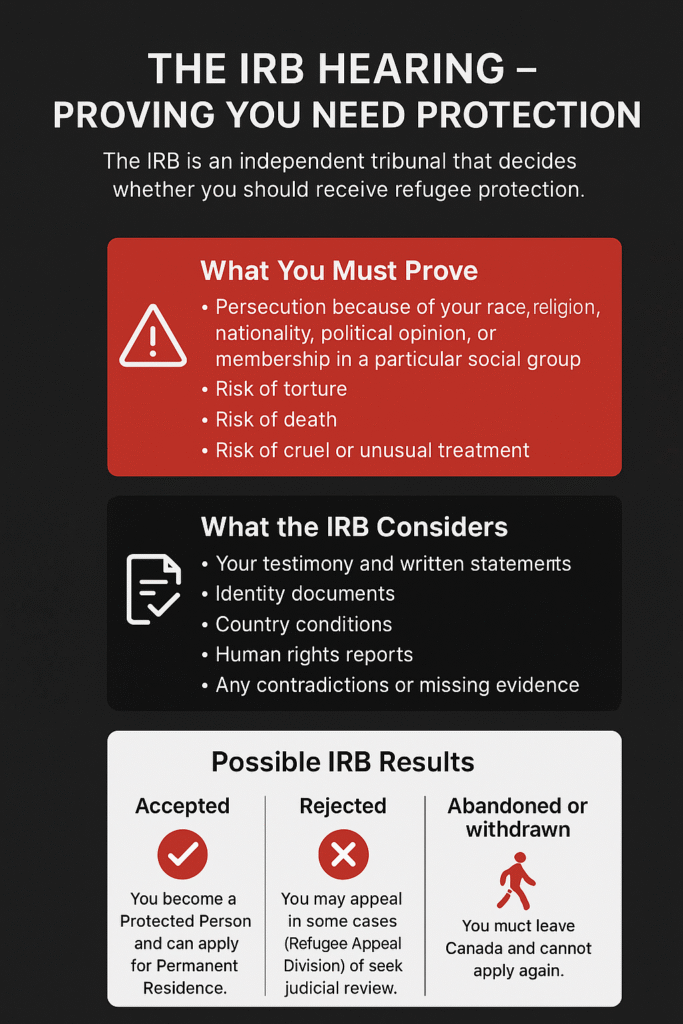
If you are found eligible, your claim is sent to the Immigration and Refugee Board of Canada (IRB) for a hearing.
If you are not eligible, the Canada Border Services Agency (CBSA) will begin removal procedures.
If you are entering Canada at an airport, land border, or seaport, you may tell a CBSA officer that you want to make a refugee claim.
🔴 Show your identity documents (passport, national ID, certificates).
🔴 Give biometrics.
🔴 Complete an interview explaining why you fear returning home.
If you meet eligibility rules, your claim is referred to the IRB for a protection decision.
If you arrive from the United States, the STCA may prevent you from making a refugee claim unless you qualify under specific exceptions, such as:
🔴 Having close family in Canada
🔴 Being an unaccompanied minor
🔴 Holding certain valid documents
If you do not qualify under an STCA exception, your claim will be refused, and you will be returned to the U.S.
If you are outside Canada and cannot safely return to your home country or integrate into the country you are currently in, you may be eligible for refugee resettlement.
You cannot apply directly to Canada on your own.
You must be referred by one of the following:
🔘 UNHCR (United Nations Refugee Agency)
🔘 A designated referral organization
🔘 A private sponsorship group
For people with a well-founded fear of persecution based on protected grounds.
For people affected by:
-Civil war
-Ongoing conflict
-Serious human-rights violations
Even if the threat is not personal or targeted.
All resettled refugees must pass:
🔘 Medical exam
🔘 Security screening
🔘 Criminal background checks
Quebec selects its own refugees using a separate provincial system.
Canadian citizens, groups, and organizations can sponsor refugees for one year.
-Housing
-Food and clothing
-Settlement support
-Emotional and community support
🔘 There are no application fees.
🔘 Sponsors cannot charge or ask for repayment.
🔘 Quebec runs its own version of this program.
🔴 Sponsorship Agreement Holders (SAHs) – approved organizations with federal agreements
🔴 Groups of Five – 5 Canadian citizens or PRs teaming up to sponsor
🔴 Community Sponsors – local groups or associations
The EMPP allows skilled refugees and displaced people to immigrate through economic immigration streams, not traditional refugee resettlement.
➲ Federal EMPP – Job offer and no-job-offer options
➲ Regional EMPP – Through Atlantic Immigration Program or Provincial Nominee Programs
🔴 No processing fees
🔴 Faster processing times
🔴Helps employers fill labour shortages
🔴 Gives refugees long-term economic stability
Anyone in Canada or at a border who fears persecution, torture, or severe harm may apply—if they meet eligibility requirements and are not barred by STCA rules or previous claims.
The IRB reviews evidence, holds a hearing, and decides whether you qualify as a Convention refugee or a person in need of protection.
Government-assisted refugees receive support funded by the government for up to a year.
Privately sponsored refugees are supported by volunteers or community groups.
No. All overseas applicants must be referred by the UNHCR or an approved organization or sponsorship group.
The EMPP allows skilled refugees to immigrate through economic pathways—making the process faster, fee-free, and connected to labour-market needs.
No. Canada does not accept direct refugee applications from individuals overseas. You must be referred by UNHCR, a designated referral organization, or a private sponsorship group in Canada.
Asylum (Refugee Claim): You apply inside Canada or at a Canadian border.
Resettlement: You apply from outside Canada through a formal referral process.
The requirements, procedures, and timelines are completely different.
Processing times vary depending on:
Country conditions
Security checks
Medical exams
Travel logistics
Sponsorship availability
Some cases move quickly, while others may take a year or more.
Depending on the program, refugees may receive:
Housing assistance
Financial support (up to 12 months)
Language training
Employment guidance
Medical coverage
Community integration support
Support is either provided by the government (GAR program) or private sponsors (PSR/BVOR programs).
Yes. For refugees facing immediate danger, Canada may process cases under:
Urgent Protection Program (UPP)
These cases move faster due to life-threatening circumstances.
It depends on the referring body, but typically:
Identity documents
UNHCR refugee certificate (if applicable)
Evidence of risk or persecution
Family details
Medical information
It is a Canadian resettlement category for people who:
Are affected by war
Face generalized violence
Experience major human-rights violations
They do not need to be personally targeted to qualify.